
Goodbye Summer: A Different Way to Rebuild Your Routine
Written by Joana Pasco, EMCC EIA, E-CYT 200 (Life Coach)
As summer fades and September begins, there's often pressure to snap back into routine overnight — as if the version of you that thrived over the summer needs to be packed away until next year. But real, sustainable change doesn't come from pressure. It comes from awareness. Rather than forcing your old schedule back into place, this season is a natural opportunity to pause and ask what you actually want your days to look like — not what you think they should look like.
Here's a different way to approach it — one that starts with noticing, not planning.
Notice What You Want to Keep
Before adding anything new to your schedule, it helps to get clear on what belongs there in the first place. Try this simple reflection: think through the things that filled your summer — activities, habits, ways of spending time — and sort each one using two questions:
● Do I want this? (Does it draw me in? How does it feel?)
● Do I need this? (Does it matter for this season of my life, regardless of how it feels?)
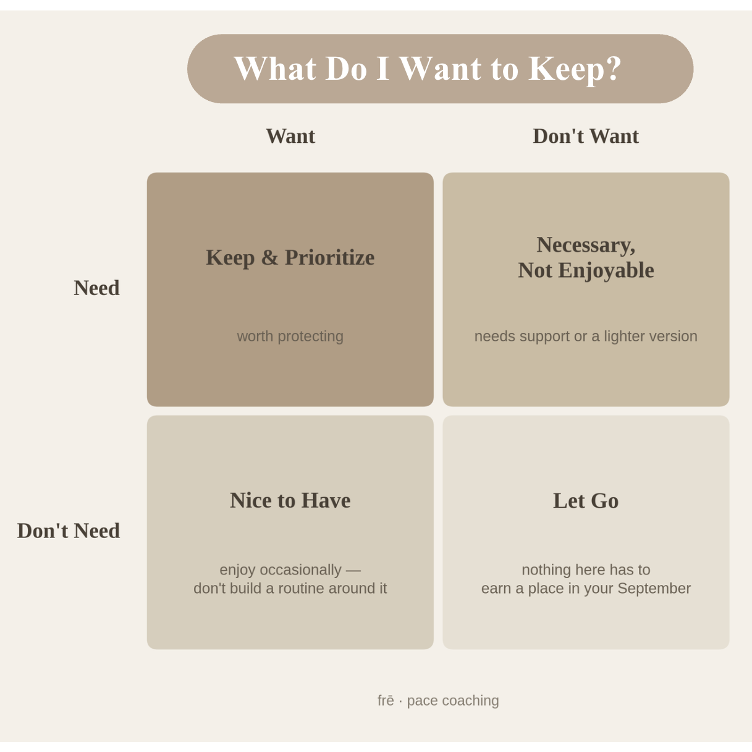
There's no wrong answer, and nothing has to land in every box. The point isn't to fill the grid — it's to notice, honestly, where things fall. What ends up in "want and need" often points you toward what your routine should actually protect — small, steady things, realistic enough to happen even in a busy week, yet meaningful enough to be worth keeping. What lands in "don't want and don't need" is simply permission to release it.
Choose an Anchor as a Reminder
Once you've sorted through the exercise above, you could pick just one thing from your "want and need" box — the one that matters most right now. Knowing what you want to protect is only half the work, though. The busier weeks have a way of blurring even our clearest intentions into the background. What helps is choosing an anchor: a small, sensory cue that brings you back to it when life gets loud.
An anchor doesn't have to be complicated. It might be:
● An object you place somewhere visible — a stone on your desk, a bracelet you wear, a note on the mirror.
● A mental image you return to — a specific moment from summer that captured how you wanted to feel.
● A song you play at the same point in your day, so it becomes a signal rather than background noise.
● A phrase or word you repeat to yourself right before or after the thing you're trying to protect.
● A small gesture — a hand on your chest, a breath, a stretch — paired with the intention until it becomes automatic.
The anchor itself isn't the routine. It's the reminder — the thing that reconnects you to what you already decided mattered, before old patterns have a chance to quietly take its place.
And one more question worth sitting with: on a scale of 1 to 10, how committed are you to following through? If the number is lower than you'd like, that's not a failure — it could be an opportunity to explore what might be getting in the way, and what could help that number rise.
A small cue, returned to often, is what slowly turns an intention into a routine — and routines built this way tend to hold up better than the ones we force into place overnight. None of this is meant to tell you what your September should look like; it's a starting point for the reflection that leads you there yourself, at whatever pace actually fits your life.
If you want to start today: I invite you to name one thing, and choose an anchor that will bring you back to it this week.
If you'd like support working through this kind of reflection, one-on-one coaching can offer the space, structure, and accountability to help you turn insight into action. Let's work together.