
When the Days Get Shorter: Supporting Your Mental Health Through the Seasonal Shift
There’s something about fall that naturally asks us to slow down.
Maybe it’s that the kids are back in school. The air is getting crisp. Or the crockpot has slowly made its way out of the bottom cupboard and onto the counter, ready for those freezer-packed meals you promised yourself would make weeknights easier.
And for those of us who are early risers, you’ve probably noticed that the mornings are darker now. Even the birds that haven’t already migrated south seem to be sleeping in a little longer.
Those slower summer days have been replaced by color-coded calendars and schedules filling up FAST. We’re spending less time outside and more time indoors. And somewhere between school drop-offs, work, activities, appointments, dinner, laundry, and everything else you’re carrying, you may notice something:
You don’t quite feel like yourself.
But you can’t really put your finger on it, can you?
Maybe you’re more tired than usual. A little less motivated. More irritable. You’re craving more sleep or more time alone. Things that felt manageable a few months ago suddenly feel heavier.
You’re not imagining it. And you’re definitely not the only one feeling it.
Changes in daylight and routine can affect our mood, energy, sleep, and overall sense of well-being. And for women already navigating a full season of life, the transition into fall and winter can feel especially noticeable.
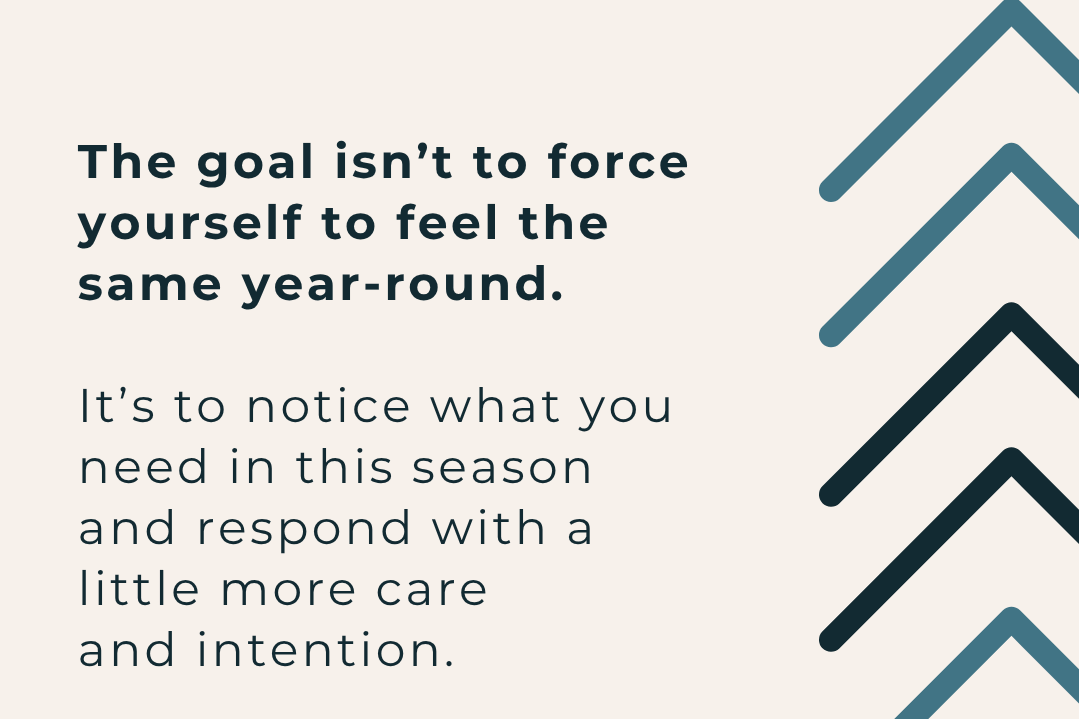
Here are a few simple ways to support your mental health and whole-body well-being as we head into fall and winter.
1. Start With Light
As daylight decreases, our natural sleep and wake cycles can shift too. You might feel sleepier earlier, have a harder time getting going in the morning, or notice that your usual energy just isn’t there.
One of the simplest things you can do is be more intentional about getting natural light.
Open the blinds when you wake up. Step outside in the morning, even if it’s only for a few minutes with your coffee. Take a midday walk when you can. On colder days, find that sunny spot near a window while you work or eat lunch.
And please, don’t turn this into another thing you have to do perfectly.
Think of it simply as giving your body a little more of what it’s missing.
2. Pay Attention to What Your Body Is Telling You
So many of us have gotten REALLY good at pushing through.
Tired? Keep going.
Overwhelmed? Get through the week.
Irritable? You probably just need more sleep.
But what if those feelings aren’t something to push past? What if they’re information?
This can be a good time of year to grab a journal, find a quiet moment, and check in with yourself. Here are a few journal questions you could use to check in:
How is your sleep?
Are you moving your body?
Are you eating regularly?
When was the last time you had real downtime?
Do you feel connected to the people you love?
And maybe most importantly:
What feels harder right now than it did a month ago?
You don’t have to immediately fix whatever comes up. Sometimes noticing it is the first step.
3. Create Small Anchors in Your Day
Supporting your mental health doesn’t have to mean completely changing your routine or adding five more things to your to-do list.
Sometimes it’s the smallest, most predictable moments that help us feel grounded when everything else feels like it’s shifting.
Five quiet minutes before the rest of the house wakes up.
A walk after dinner.
Stretching before bed.
Putting your phone down a little earlier.
Journaling.
A few minutes of breathwork. Not sure where to start? Try this simple breathing practice: Breathing for Activation vs Danger
Making yourself an actual lunch instead of eating whatever is left on your child’s plate.
And yes, drinking your coffee while it’s still hot instead of finding it lukewarm on the counter two hours later.
You are allowed to take care of yourself before every single person around you has been taken care of.
Choose one or two small things that make you feel a little more like yourself and protect them.
4. Let Your Routine Change With the Season
The routine that worked in July might not be what your mind or body needs in October.
And that’s okay.
Instead of asking yourself, “Why can’t I keep up?” try asking, “What would support me better right now?”
Maybe your body needs more rest. Maybe your workouts look different. Maybe your social calendar needs a little more breathing room.
Or maybe you need the opposite. You might notice yourself wanting to stay home more and need to be intentional about maintaining connection with the people who help you feel like you.
There’s a difference between slowing down in a way that restores you and pulling away because you’re struggling.
Pay attention to that difference.
5. You Don’t Have to Wait Until Things Feel “Bad Enough”
This might be the most important reminder of all.
You don’t have to reach a breaking point to ask for support.
If changes in your mood, anxiety, sleep, motivation, relationships, or energy are beginning to affect your everyday life, therapy can give you a place to slow down and understand what’s going on beneath the surface.
Maybe there are patterns you’re ready to understand. Stress you’ve been carrying longer than you realized. Past experiences that are still showing up in the present. Or maybe you simply need one place where you don’t have to be the person holding everything together.
You’re allowed to have support, too.
And if you’re already in therapy or doing the emotional work, sometimes the next layer of support is looking at the whole person.
At Center for Collaborative Health, therapy can work alongside wellness services such as acupuncture, nutrition, physical therapy, life coaching, trauma-sensitive yoga, breathwork, shamanic healing, and other integrative offerings.
Because your mental health doesn’t exist separately from the rest of you.
Your sleep matters. Your stress matters. Your body matters. Your relationships matter. Your experiences matter.
And sometimes feeling better starts by giving yourself permission to be human.
As the days get shorter, consider this your invitation to check in with yourself: What would make this season feel a little more supported?
If therapy feels like the place to start, our team of therapists is here to meet you where you are. And if you’re already receiving mental health support but feel like your body, energy, stress, or overall wellness could use some additional care, explore our wellness services and discover what might complement the work you’re already doing. Ready to take the next step? Schedule an appointment with one of our providers.
Not sure where to begin? Take our free Holistic Health Quiz to help identify areas where you may benefit from additional support.